

Remember and use the words you need for IELTS.
VocabSprint teaches each word with the phrases it is used in, then brings it back just before you would forget it. A few minutes a day is enough. For iPhone and iPad.
Coming soon to the App StoreFor iPhone and iPad, iOS 18 or later
See a session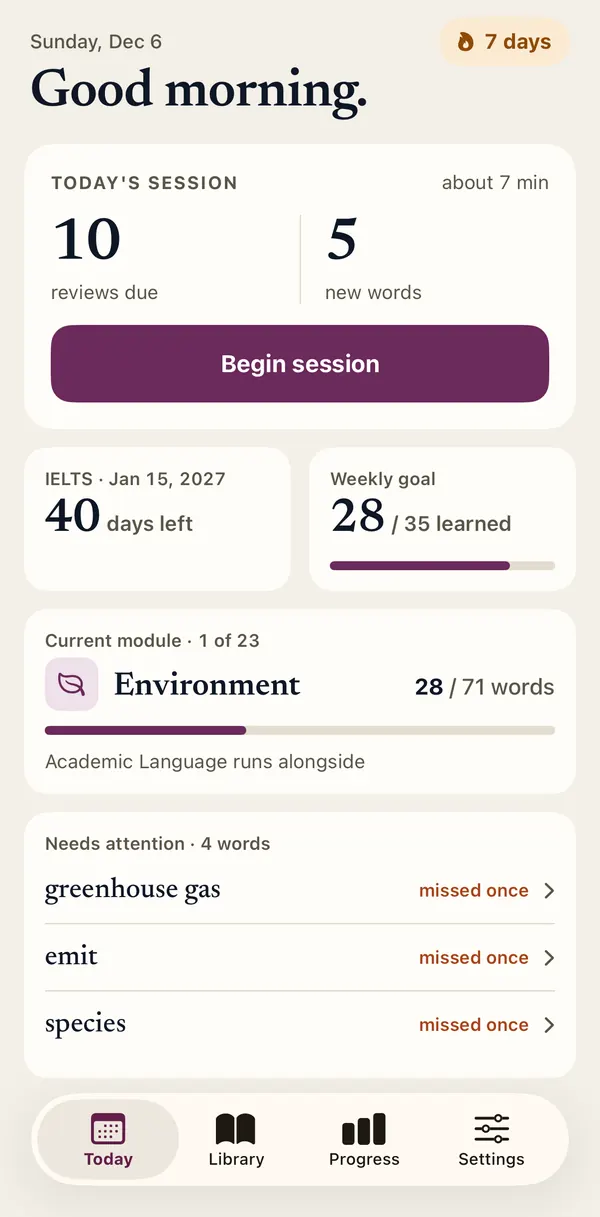
Why another vocabulary app
A word list gives you the meaning. The exam wants to see you use it.
By B2 you already know most of the words. What lets you down is putting them together the way a fluent writer would. The IELTS band descriptors for vocabulary mention collocation from Band 7 up, and a list of single words won't teach you that.
make urgent action
do a big role
You know what “action” and “role” mean. But when the clock is running, you reach for the verb your first language would use.
take urgent action
play a major role
Every word comes with the phrases it is normally used in, plus the pairings learners often get wrong, marked as not natural. Then you practise picking the natural one.
What a word page shows
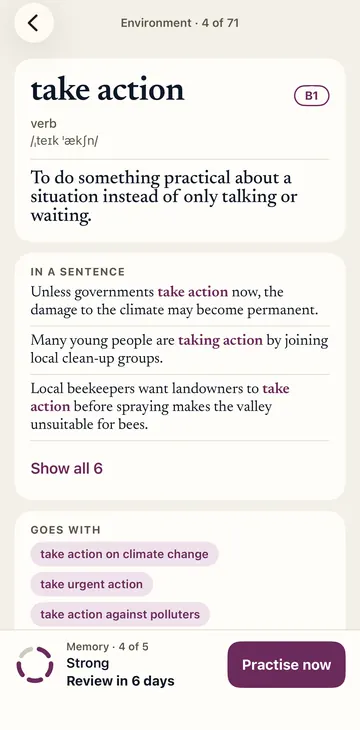
Everything about a word, on one page
To do something practical about a situation instead of only talking or waiting.
In a sentence
Unless governments take action now, the damage to the climate may become permanent.
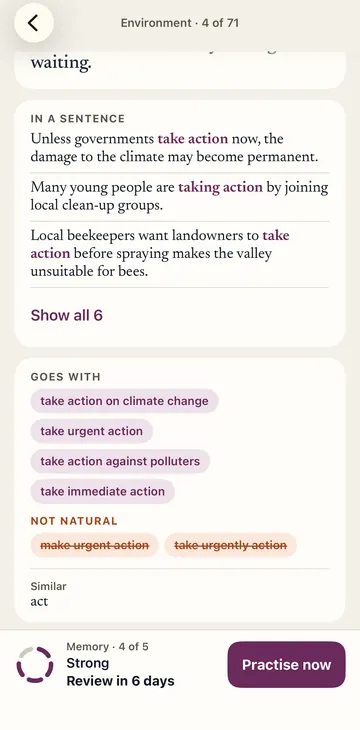
Goes with
- take urgent action
- take action against polluters
- take immediate action
Not natural
- Not natural: make urgent action
- Not natural: take urgently action
- A meaning in plain EnglishWritten for learners, not copied from a dictionary. The word's level and part of speech sit beside it.
- Six example sentencesSet in the topics IELTS asks about, with the word highlighted.
- The phrases it goes withThe collocations a Band 7 answer uses, and the pairings that sound wrong, crossed out.
- Pronunciation, written outBritish or American, in IPA. You choose which one you see.
- How well you know itHow strong the word is in your memory and when it comes back. Want another go now? Tap Practise now.
How a session works
A few minutes, a few kinds of question
A session starts with the words that are due, then adds a few new ones. As you get to know a word, the questions change: first you recognise it, then you produce it.
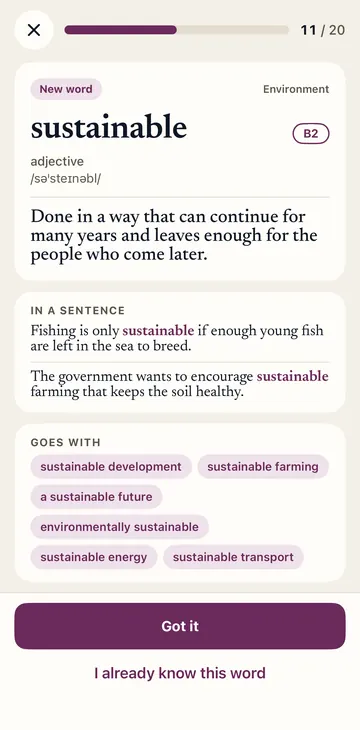
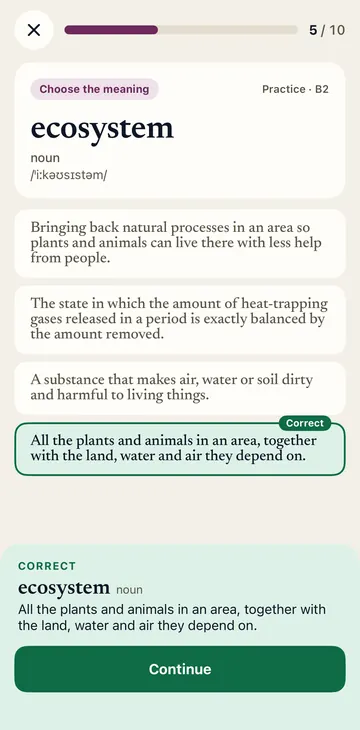
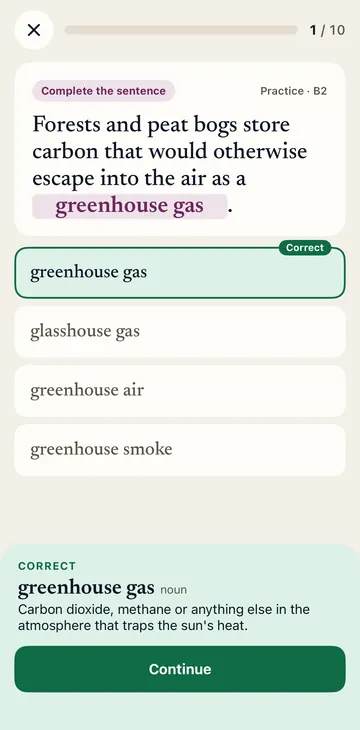
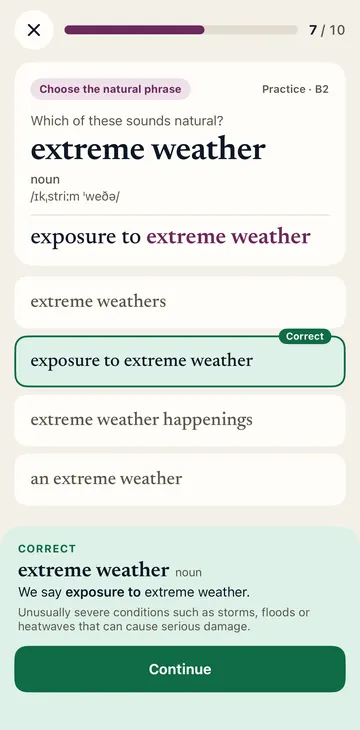
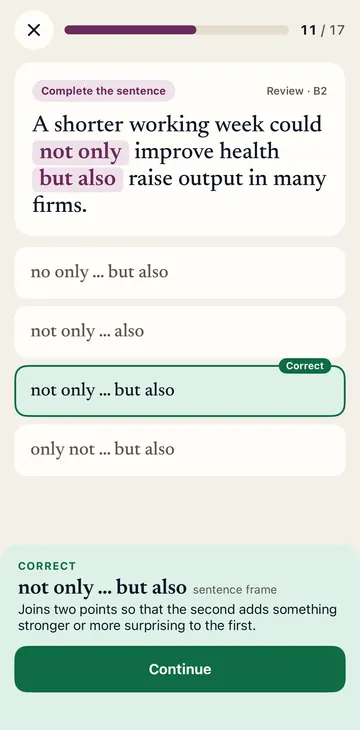
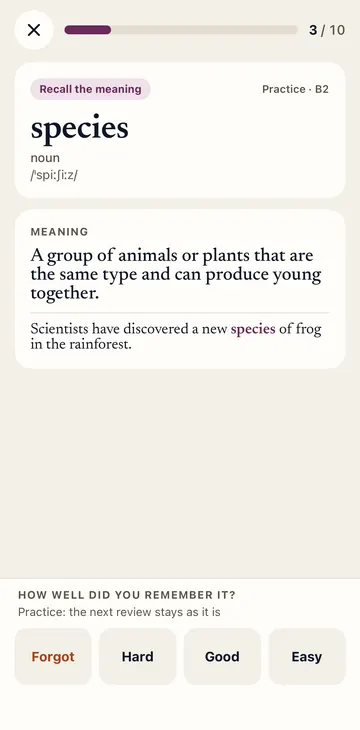
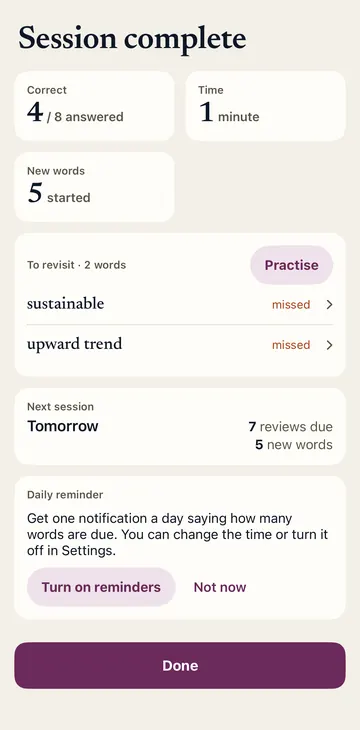
- 1Meet the new wordBefore any question, a new word gets its own card: the meaning, examples and the phrases it goes with. Already know it? Say so, and another word takes its place.
- 2Choose the meaningFour definitions, one right. Not sure? Tap “I don't know” rather than guess.
- 3Complete the sentenceThe word in a sentence, among options that look almost right.
- 4Choose the natural phraseWhich words go together? This is where collocations stick.
- 5Sentence frames, in two partsFrames for essays and speaking, like “not only … but also”, filled in inside a real sentence.
- 6Recall it yourselfSee the word, say the meaning to yourself, then check. You rate how well you knew it.
- 7See how it wentWhat you got right, which words to look at again, and what tomorrow's session holds.
The method
Built so the words stay
Reviews timed to your memory
The app uses FSRS, an open spaced-repetition algorithm, to work out when each word is about to slip, and brings it back then. Easy words come back less often; the ones you miss come back sooner.
You set the pace
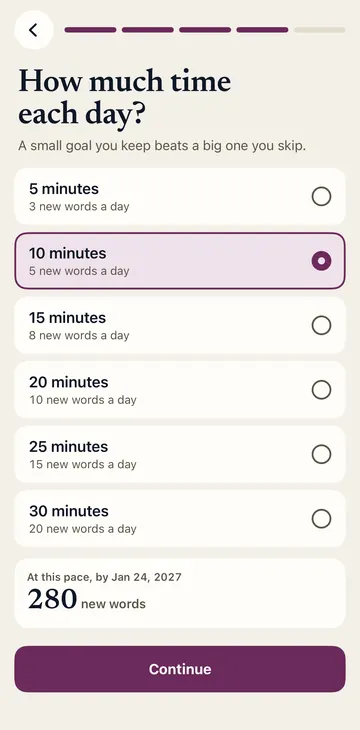
Choose how many new words you want a day, up to 20. Reviews always come first, so adding new words never means losing old ones.
A plan for your exam date
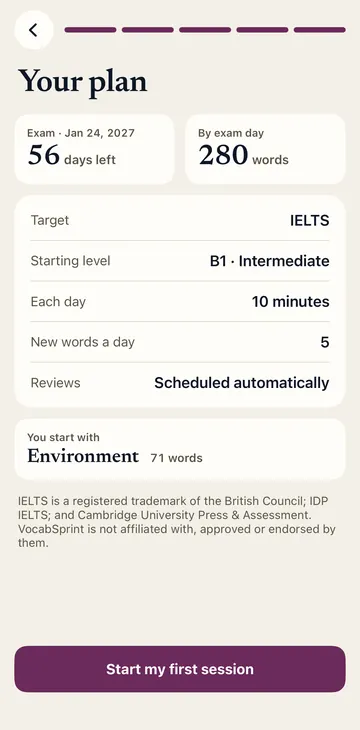
Tell the app when your exam is. It shows the days left and how many words you will have covered by then. No date yet? It plans for steady progress instead.
Works offline, no account
Everything you need to study is on your phone. There is nothing to sign up for, and sessions work on a plane or on the underground.
Your progress on every device
If you use iCloud, your progress is kept in your own iCloud account and follows you to your other iPhone or iPad. Without it, everything stays on the device.
Written for this app
Every definition, example sentence and collocation list was written for VocabSprint. Nothing is copied from a dictionary.
Your plan, from the first minute
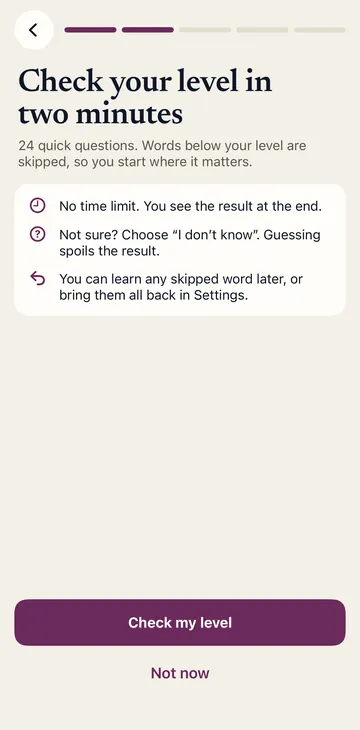
When you start, the app asks for your level, your exam date and how much time you have each day. Not sure of your level? Take the short level check, or skip it. Words below your level are set aside, and you can bring them back whenever you like.
The plan you see at the end is the one the app follows. You can change the date or the pace in Settings at any time.
How the words are grouped
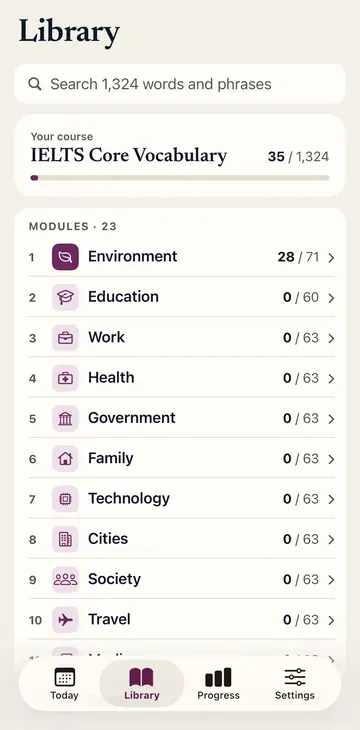
Topics
17 topics
The subjects IELTS keeps coming back to.
- Environment
- Education
- Work
- Health
- Government
- Family
- Technology
- Cities
- Society
- Travel
- Media
- Economy
- Food
- Science
- Crime
- Culture
- Globalisation
Academic Language runs alongside: one new word in five comes from it.
Exam skills
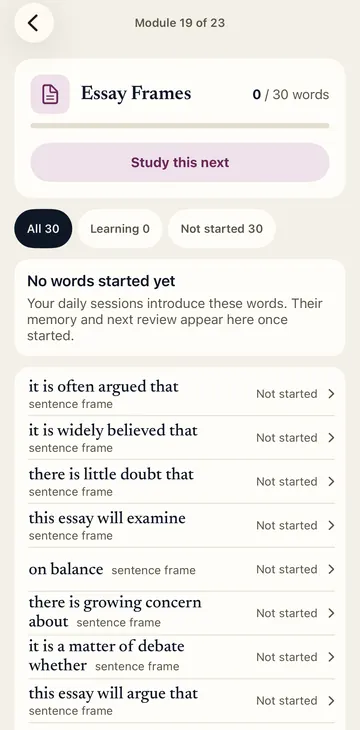
6 modules
Aimed at parts of the test, not at a subject.
- Linking Words
- Essay Frames
- Describing Data
- Processes and Maps
- Describing Objects
- Discussion Phrases
Task sets
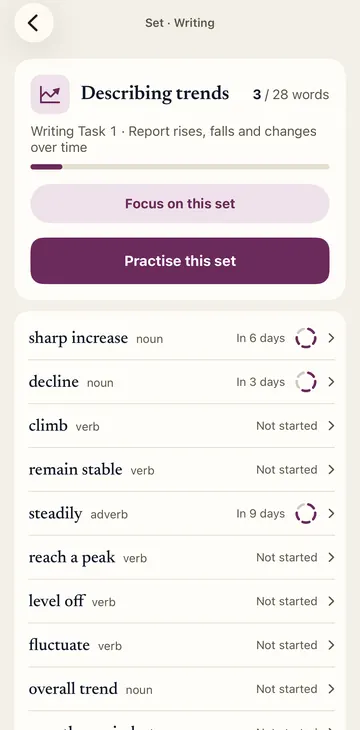
12 sets
Words for one exam task. Focus on a set and new words come from it first.
Writing
- Describing trends Task 1
- Comparing proportions and figures Task 1
- Stating and supporting an opinion Task 2
- Discussing both sides Task 2
- Explaining causes, effects and solutions Task 2
- Opening and closing an essay Task 2
Speaking
- Talking about yourself Part 1
- Describing a person Parts 1 and 2
- Describing a place Parts 1 and 2
- Describing an experience or event Part 2
- Giving and justifying opinions Part 3
- Speculating and comparing Part 3
See how ready you are
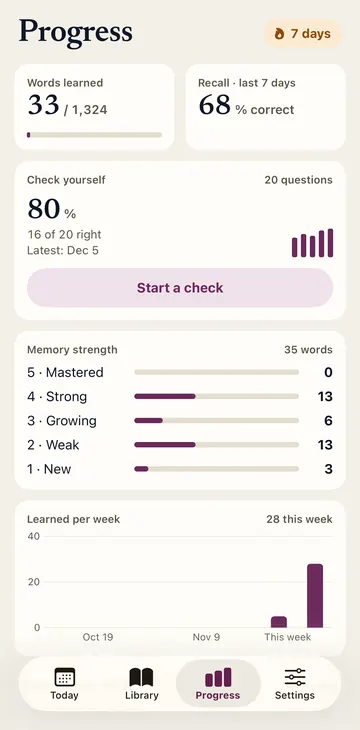
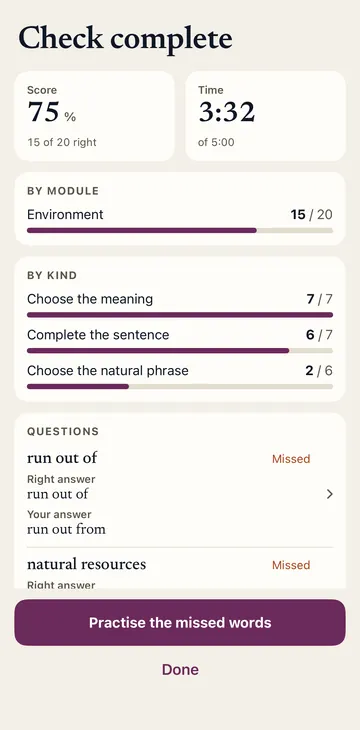
Progress shows how many words you have learned, how strong each one is, and how your weeks are going. When you want a straight answer, start a timed check: up to 20 questions on words you have already met, 15 seconds each, no feedback until the end. It doesn't change your review schedule.
Pricing
Start free. Subscribe when it's working for you.
Free
$0
No time limit, no account.
- The first topic module, with Academic Language alongside
- Up to 5 new words a day
- Reviews of everything you've learned, with no cap
- The level check and the timed check
Premium, yearly Best value
$39.99 a year
7 days free, then $39.99 a year (about $3.33 a month).
- Every module, including the exam-skill modules
- Up to 20 new words a day
- New modules as they're published
Premium, monthly
$6.99 a month
Cancel any time.
- Everything in the yearly plan
- Billed monthly, no free trial
Prices are in US dollars. They vary by country and currency, and the App Store shows you the exact price before you confirm. Subscriptions renew automatically through your Apple Account until you cancel, which you can do at any time in your iPhone's Settings. See the terms.
Questions
Before you start
Who is VocabSprint for?
Mostly IELTS candidates between B1 and C1 who are aiming for Band 7, and who have noticed that knowing what a word means isn't the same as using it well. The words stay useful after the exam too: they are the vocabulary of university and work.
Which languages are supported?
The app's menus and buttons are in English or Turkish. Meanings, example sentences and questions are always in English, as they are in the exam. Turkish speakers can also see a short Turkish meaning beside each word.
Do I need an account or an internet connection?
No account: there is nothing to sign up for. Studying works offline. The app goes online to download new words and corrections, to sync through iCloud if you use it, and to check your subscription with the App Store. It also sends anonymous usage counts, which you can turn off in Settings; the privacy policy lists what they contain.
Will my progress move to a new phone?
Yes, if you use iCloud. When you are signed in to iCloud, your progress is kept in your own iCloud account, so it appears on a new iPhone, or on your iPad, signed in with the same Apple Account. Without iCloud, it stays on the device you study on.
How many new words should I learn a day?
Fewer than you think. The default is five, and that adds up quickly, because each word keeps coming back until it sticks. Every new word also adds reviews, so a number you can keep up every day beats a big one you skip.
Will it guarantee my band score?
No, and no app can. VocabSprint helps you build and keep the vocabulary the Lexical Resource criterion rewards. Your score depends on the whole exam and on how you prepare for it.
What happens if I cancel?
You keep Premium until the end of the period you've paid for. After that you're on the free plan: everything you've learned stays, and you keep reviewing it.
Which devices does it run on?
iPhone and iPad with iOS or iPadOS 18 or later. On iPad the screens use the full width.
Five words today. Still there next month.
Coming soon to the App StoreFor iPhone and iPad